

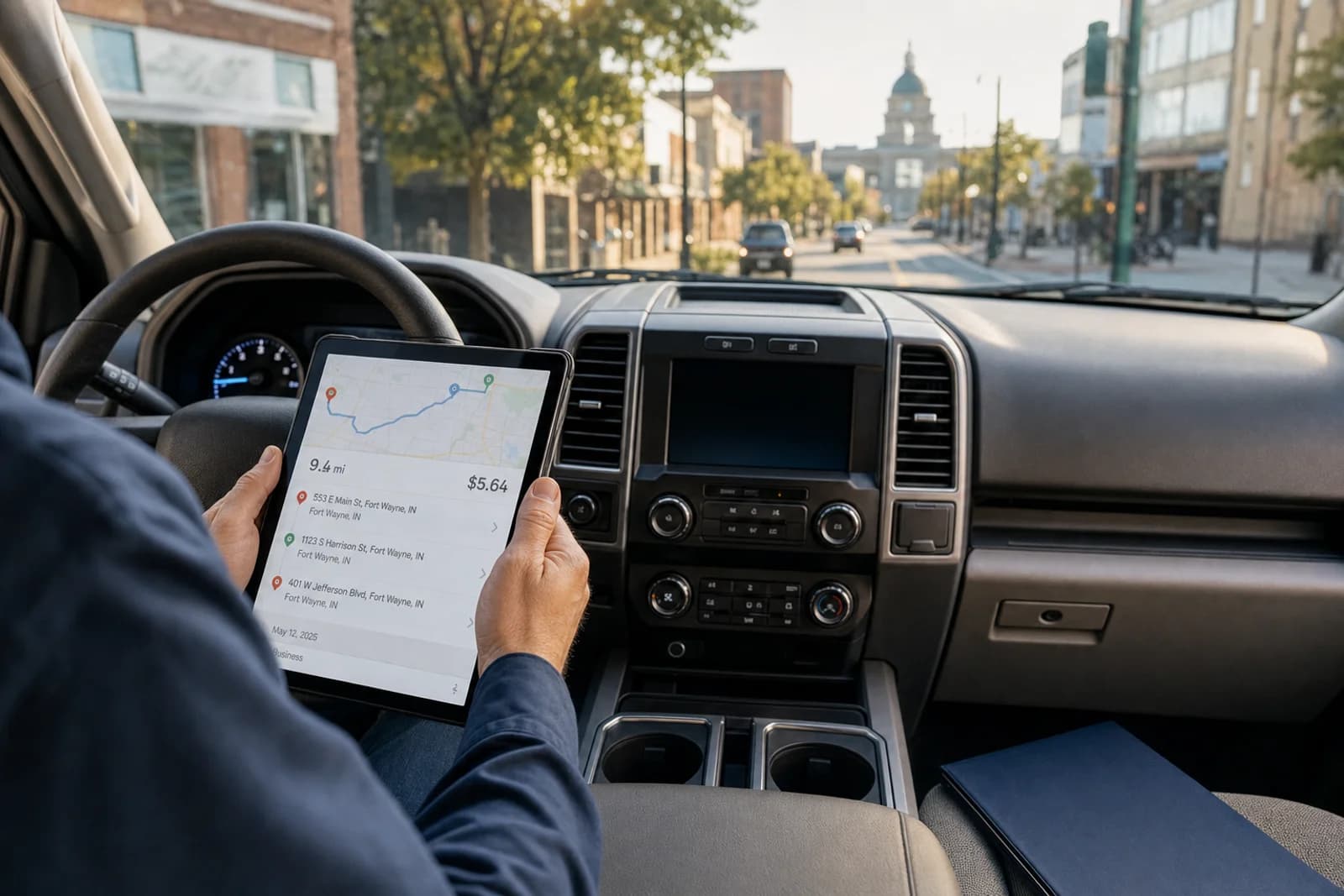

Every year, the IRS reviews fuel costs, vehicle depreciation, and maintenance data before announcing whether the standard mileage rate will rise, fall, or hold steady. For 2026, the business mileage rate is 70 cents per mile — up from 67 cents in 2024 and holding the same level set in 2025. If you drive for client visits, job sites, supply runs, or any other ordinary business purpose, that 3-cent swing from 2024 adds up faster than you might expect.
Whether you run a service route through Allen County, haul materials to a construction site in DeKalb County, or make sales calls across NE Indiana, getting your mileage deduction right is one of the simplest ways to reduce your tax bill without spending a dollar. Here's what you need to know for 2026.
What Is the IRS Standard Mileage Rate and How Does It Work?
The standard mileage rate is a per-mile deduction the IRS allows in place of tracking every actual vehicle expense — gas, oil, tires, insurance, and depreciation. You multiply your total business miles by the rate, and that's your deduction. No receipts for every fill-up required.
The IRS sets separate rates for three categories of driving:
Business use: 70 cents per mile (2026)
Medical or moving (active-duty military only): 21 cents per mile
Charitable service: 14 cents per mile (set by statute, rarely changes)
Only the business rate is relevant for most small-business owners and self-employed individuals. The rate is meant to be a simplified proxy for the true cost of operating a vehicle. The IRS derives it from an annual study of fixed and variable vehicle costs — which is why it tends to track fuel prices and shifts in the consumer price index.
One important detail: if you use the standard mileage rate, you generally cannot also deduct actual vehicle expenses for the same vehicle in the same year. You choose one method, and in many cases you must stick with it for the life of the vehicle if you start with the standard rate.
How Much More Can You Deduct in 2026 Compared to Recent Years?
Compared to 2024's rate of 67 cents, the 2026 rate of 70 cents means an extra $3 of deduction for every 100 miles driven for business — small per trip, but meaningful over a full year of driving.

To put some numbers on it: if you drive 15,000 business miles in 2026, your deduction works out to $10,500. At the 2024 rate, that same driving would have produced a $10,050 deduction — a difference of $450. For a business owner in the 22% federal tax bracket, that's roughly $99 more in tax savings just from the rate increase, before you factor in Indiana's state income tax.
Here's a quick comparison across recent years:
Tax Year Business Rate (per mile) Deduction on 15,000 Miles 2023 65.5 cents $9,825 2024 67 cents $10,050 2025 70 cents $10,500 2026 70 cents $10,500
The trend has generally been upward since 2021, and the 2025–2026 rate represents the highest standard mileage rate for business in recent memory. If you've been sloppy about logging miles, now is a great time to tighten that habit.
Who Qualifies to Use the Standard Mileage Rate?
Most self-employed individuals and small-business owners can use the standard mileage rate, but a few eligibility rules apply. You cannot use the standard rate if you previously claimed MACRS depreciation on the vehicle, used Section 179 expensing, or claimed a special depreciation allowance in an earlier year for that vehicle.
Additional restrictions to be aware of:
You must own or lease the vehicle (you can't use the rate for a vehicle you borrow).
If you operate five or more vehicles simultaneously in your business (a fleet), you generally cannot use the standard rate — you must track actual expenses.
The commute from home to your regular office is never deductible — only miles driven for genuine business purposes count.
Employees who are reimbursed by their employer for mileage at the IRS rate do not owe income tax on those reimbursements, making the rate equally useful for payroll planning.
If you're unsure whether the standard rate or the actual-expense method produces a bigger deduction for your specific vehicle and usage pattern, your CPA at Warrior can run the numbers both ways before you commit.
What Records Do You Need to Claim a Mileage Deduction?
Good recordkeeping is the difference between a deduction that holds up and one that gets wiped out in an audit. The IRS requires contemporaneous records — meaning you log the trip close to when it happens, not from memory at tax time.
For each business trip, your mileage log should capture:
The date of the trip
The business purpose (e.g., "client meeting — ABC Manufacturing, Auburn, IN")
The starting and ending location
The odometer reading at start and end, or total miles for the trip
A mileage-tracking app (MileIQ, Everlance, TripLog, and others) does this automatically in the background as you drive and exports a clean report at year-end. That report is exactly what you hand your CPA and, if it ever comes to it, the IRS. If you're still using a paper log in the glove box, that works too — just be consistent. For more guidance on how vehicle records fit into your broader bookkeeping picture, see our bookkeeping services page.
Should You Use the Standard Mileage Rate or Track Actual Expenses?
The standard mileage rate wins on simplicity; actual expenses sometimes produce a larger deduction — especially for heavier, less fuel-efficient vehicles or vehicles with high depreciation. Choosing the right method depends on your vehicle's cost, fuel economy, insurance premiums, and how many miles you drive for business versus personal use.
As a rough rule of thumb, the standard rate tends to favor owners of efficient, lower-cost vehicles who drive moderate-to-high business mileage. Actual expenses tend to favor owners of expensive vehicles, trucks, or vans where depreciation and operating costs are high relative to miles driven.
Keep in mind that Indiana also conforms to most federal vehicle deduction rules, so your choice affects both your federal return and your Indiana adjusted gross income. Our tax planning services include a vehicle deduction analysis as part of a broader strategy review — especially useful if you're considering purchasing a new vehicle before year-end.
What Else Should NE Indiana Business Owners Know About 2026 Tax Changes?
Mileage is one piece of a larger 2026 tax picture. Several provisions from the Tax Cuts and Jobs Act of 2017 are set to expire or phase down after 2025, which could affect your standard deduction, pass-through deduction (Section 199A), and individual rates starting in the 2026 tax year. That makes proactive tax planning more important than ever heading into this filing cycle.
If your books aren't current — or if you're unsure whether your mileage logs, vehicle records, and expense categories are set up correctly — now is the right time to get ahead of it. Our cleanup and catch-up bookkeeping service can get you organized before year-end deadlines arrive.
Reach out to Warrior Business Services in Fort Wayne — Stuart and the team are ready to help you make sure every legitimate deduction, including every mile you drive, is working as hard as possible for your business.
Sources
IRS Announces Standard Mileage Rates for 2025. Internal Revenue Service. 2024. https://www.irs.gov/newsroom/irs-announces-standard-mileage-rates-for-2025
Publication 463: Travel, Gift, and Car Expenses. Internal Revenue Service. 2024. https://www.irs.gov/publications/p463
Rev. Proc. 2019-46 (Standard Mileage Rate Methodology). Internal Revenue Service. 2019. https://www.irs.gov/pub/irs-drop/rp-19-46.pdf
Publication 15-B: Employer's Tax Guide to Fringe Benefits. Internal Revenue Service. 2024. https://www.irs.gov/publications/p15b
Topic No. 510: Business Use of Car. Internal Revenue Service. 2024. https://www.irs.gov/taxtopics/tc510
Indiana Individual Income Tax Overview. Indiana Department of Revenue. 2024. https://www.in.gov/dor/individual-income-taxes/
Tax Cuts and Jobs Act — Expiring Provisions. Congressional Budget Office. 2024. https://www.cbo.gov/topics/taxes

Written by
Warrior Business Services
Warrior Business Services is a boutique CPA firm in downtown Fort Wayne, Indiana, advising family-owned businesses and growth-minded owners across Northeast Indiana.