


Fort Wayne's downtown revitalization creates property tax reassessments, new TIF districts, and growth incentives that directly impact small business tax planning.
What tax changes are Fort Wayne small businesses seeing from downtown development?
Fort Wayne small businesses near downtown are primarily seeing property tax increases driven by reassessments that reflect rising property values in revitalized neighborhoods. As the Electric Works project, riverfront improvements, and new mixed-use developments enhance the area's appeal, Allen County's assessor adjusts valuations upward—sometimes by 20-40% in hotspot corridors like West Main Street and the Landing. These reassessments directly increase your tax bill, even if your business operations haven't changed, because Indiana property taxes are calculated by multiplying your assessed value by local tax rates.
TIF Districts and How They Work
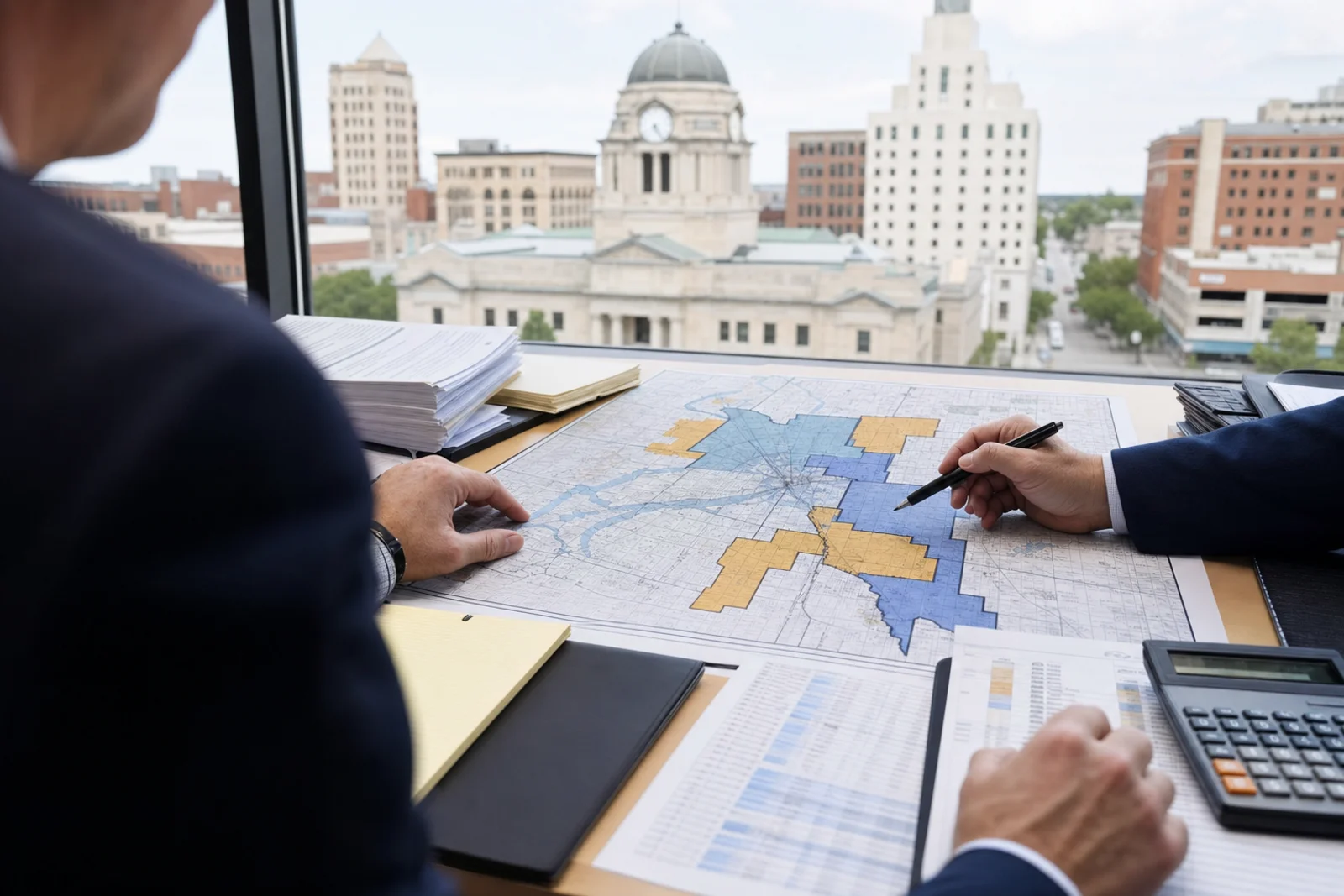
Many downtown projects sit within Tax Increment Financing (TIF) districts, which redirect property tax growth to fund infrastructure rather than general city services. In Fort Wayne's Riverfront TIF and Downtown TIF, the "base" property tax revenue goes to schools and libraries as usual, but any increase above that baseline—the "increment"—funds bonds for streetscapes, utilities, and parking garages. This structure doesn't directly raise your rate, but it can limit funds available for other municipal needs, occasionally shifting budget pressures elsewhere in Allen County.
Citywide Ripple Effects
Downtown's growth also affects businesses outside the core. Rising commercial valuations downtown can slightly lower tax rates citywide because Indiana's tax caps and rate calculations spread the levy across a larger total assessed value. However, if your own property simultaneously increases in value—common in adjacent neighborhoods like West Central—you may still see a net increase. Tracking your business advisory needs through reassessment cycles helps you anticipate cash flow impacts and explore appeals if valuations seem inflated relative to comparable properties.
How do Tax Increment Financing (TIF) districts affect my Fort Wayne business taxes?
Tax Increment Financing districts don't change what you pay in property taxes, but they do redirect where a portion of those taxes go. If your business owns property in a Fort Wayne TIF district, you'll pay the same millage rate as comparable properties outside the district. However, the "increment"—the additional tax revenue generated above the district's baseline assessed value—gets allocated to fund specific development projects rather than flowing to schools, libraries, and other taxing units as it normally would.

Fort Wayne has established several TIF districts in the downtown core and surrounding neighborhoods, including areas along Calhoun Street, near the riverfront, and within the Electric Works development zone. These districts aim to finance infrastructure improvements, parking structures, utilities upgrades, and public amenities that make the areas more attractive for business investment. The City of Fort Wayne's Redevelopment Commission administers these districts and determines how captured revenues get spent.
What This Means for Property-Owning Businesses
Your actual tax bill remains unchanged—you won't see a separate TIF line item or surcharge. The difference is invisible to property owners but significant for municipal budgeting. If your property's assessed value increases because of neighborhood improvements (new streetscaping, better utilities, increased foot traffic), the tax revenue from that increase funds further TIF projects rather than schools or the general fund.
For businesses leasing rather than owning, TIF districts have zero direct tax impact. Your landlord handles property taxes regardless. However, TIF-funded improvements—better parking, upgraded facades, increased safety measures—can boost your location's value and potentially justify higher lease rates over time. Understanding which business tax considerations apply to your specific Fort Wayne location helps you plan for long-term occupancy costs as downtown continues its transformation.
What tax credits and incentives are available for businesses moving downtown?
Fort Wayne businesses relocating or expanding downtown can access several state and local tax incentives that significantly reduce relocation costs and ongoing tax liability. Indiana Enterprise Zone credits offer income tax credits for businesses operating in designated zones covering portions of downtown Fort Wayne, while the city's Downtown Improvement District provides façade grants and the Fort Wayne Redevelopment Commission offers Tax Increment Financing (TIF) support for qualifying projects. These incentives can offset renovation expenses, equipment purchases, and even create ongoing payroll tax benefits for new hires within the zone.
Indiana Enterprise Zone Benefits
The Fort Wayne Enterprise Zone encompasses significant portions of downtown and offers income tax credits equal to the state tax liability attributable to zone income, loan interest deductions up to $7,500 annually for zone property improvements, and a $1,500 employee tax credit for each qualifying worker who lives in the zone. These credits reduce your Indiana tax liability dollar-for-dollar, making downtown expansion considerably more affordable than suburban alternatives.
Historic Preservation Tax Credits
Fort Wayne's numerous historic buildings qualify for both federal (20% of qualified rehabilitation expenses) and Indiana state (20% additional credit) historic preservation tax credits when renovations meet Department of Interior standards. Combined, these credits effectively cover 40% of your renovation costs for buildings on the National Register, making historic storefronts financially competitive with new construction.
Local Façade and Investment Programs
The Downtown Improvement District administers façade improvement matching grants covering up to 50% of exterior renovations (maximum $25,000), while Allen County Economic Development offers additional incentives for job creation and capital investment. Our tax planning service helps Fort Wayne businesses layer these incentives strategically to maximize total tax benefit while ensuring compliance with program-specific requirements and recapture provisions.
Should I relocate my Fort Wayne business downtown for tax advantages?
Relocating downtown rarely makes sense purely for tax advantages, but the combination of incentives, operational benefits, and strategic positioning can create a compelling business case. The decision hinges on whether the total financial impact—including tax breaks, increased revenue potential, and higher operating costs—improves your bottom line over a 5–10 year horizon.
Downtown Fort Wayne offers several potential tax-related benefits. Properties within designated zones may qualify for real property tax abatements on improvements, typically phasing in over 5–10 years. If you're purchasing or constructing, these abatements can significantly reduce your occupancy costs during the early years when cash flow matters most. Additionally, certain census tracts downtown qualify for federal Opportunity Zone treatment, allowing investors to defer capital gains if they're rolling proceeds into your business real estate.
However, downtown locations typically command higher lease rates—often $16–$24 per square foot compared to $10–$15 in suburban Fort Wayne corridors. Property values have risen 30–40% in core downtown blocks since 2018, increasing your acquisition costs if purchasing. You'll also face higher insurance premiums and potentially increased payroll expenses if competing for talent in a denser employment market.
Creating your relocation decision framework
Start by modeling a conservative 7-year scenario comparing your current location against downtown. On the benefit side, quantify available tax abatements, estimate revenue increases from better visibility and foot traffic, and calculate time savings from proximity to banks, attorneys, and professional services. On the cost side, factor in moving expenses, higher rent or mortgage payments, increased parking costs for employees, and potential business interruption during the transition.
Most Fort Wayne businesses find downtown relocation makes sense when they're already planning facility changes and can leverage multiple advantages simultaneously—not for tax savings alone. Our tax planning team can model the specific numbers for your situation, ensuring you're not leaving money on the table or making an expensive mistake based on incomplete information.
How does downtown growth impact my business entity structure and tax strategy?
Downtown Fort Wayne's redevelopment creates opportunities where your entity structure directly affects how much tax you keep versus pay. If you're operating in an appreciating area—whether leasing, owning your space, or planning to expand—choosing between an LLC taxed as an S-corp versus remaining a single-member LLC changes your self-employment tax bill, your ability to shelter real estate gains, and how cleanly you can exit when downtown values peak. As property values rise along Calhoun Street and the riverfront, structuring correctly now prevents expensive restructuring later.
S-Corp vs. LLC in Growth Corridors
An S-corporation election reduces self-employment taxes on business income—critical when downtown revenues climb—but complicates real estate ownership. If you hold the building your brewery or consulting firm occupies, keeping real estate in a separate LLC protects you from double taxation on appreciation when you sell. The S-corp pays you reasonable wages (subject to payroll tax), while rental payments to your property LLC shift income without the 15.3% self-employment hit on every dollar.
Cost Segregation and Building Improvements
Renovating a historic downtown building? Cost segregation studies reclassify components—HVAC, electrical, interior finishes—from 39-year depreciation to 5-, 7-, or 15-year schedules, front-loading deductions. For a $500,000 buildout, this can accelerate $150,000+ in depreciation to year one under bonus depreciation rules, reducing Indiana taxable income immediately. Fort Wayne's renaissance means more businesses are tackling these projects—and missing five-figure tax savings by not segregating costs.
Succession Planning in Appreciating Markets
If your downtown business or real estate has doubled in value since 2015, exit planning now—before selling—structures the sale to minimize capital gains. Installment sales, charitable remainder trusts, or opportunity zone reinvestment (if selling property near qualified census tracts) can defer or reduce federal and Indiana tax bills. Waiting until a buyer appears leaves you scrambling with the structure you have, not the one that saves taxes.
What Fort Wayne tax planning steps should I take now with downtown changing?
Start by requesting a property tax assessment review before March 31 if your property value increased significantly in the last year, and schedule a mid-year tax planning session with your CPA to model different scenarios as downtown development shifts property values and potential income. This proactive approach prevents surprises and positions you to capture available incentives before application windows close.
Immediate Actions (Next 90 Days)
Request your current assessment: Contact the Allen County Assessor's office to obtain your property's assessed value and comparable sales data for neighboring parcels affected by downtown improvements
Document property conditions: Photograph any deferred maintenance, functional obsolescence, or factors that might justify a lower assessment than surrounding renovated properties
Review your entity structure: If you're operating as a sole proprietor or partnership near the downtown corridor, evaluate whether S-corp conversion makes sense given projected income changes from increased foot traffic
Inventory potential incentive programs: Compile a list of City of Fort Wayne, Allen County, and Indiana Economic Development Corporation programs you might qualify for, noting application deadlines
Mid-Year Planning (April–August)
File property tax appeals by June 15: Indiana's appeal deadline falls shortly after you receive assessment notices in spring
Model tax scenarios: Work with your CPA to project tax liability under different revenue assumptions as downtown activity increases
Apply for targeted incentives: Many Fort Wayne redevelopment programs have summer deadlines for the following tax year
Year-End Review (September–December)
Schedule a comprehensive tax planning session by October to implement strategies before year-end, including equipment purchases, retirement contributions, and expense acceleration that align with your changing business environment.

Written by
Warrior Business Services
Warrior Business Services is a boutique CPA firm in downtown Fort Wayne, Indiana, advising family-owned businesses and growth-minded owners across Northeast Indiana.